
ALPHA PERSPECTIVES | SEPTEMBER 2026
Macro • Markets • Alternatives
Prashant Kothari
CEO – International Business
Executive Summary
Investors have spent the past year focused on tariffs, AI capex, fiscal deficits, and central bank credibility. A different inflation driver has been building beneath the surface. The FAO Food Price Index hit 133.3 in August 2026, its highest level since late 2022.¹ Wheat futures are up roughly 43% year-on-year.² JPMorgan forecasts global food inflation accelerating from 2.8% to 5% between H1 2026 and H1 2027.³ Notably, August’s increase was not confined to one commodity: prices rose across cereals, vegetable oils, sugar, meat, and dairy alike.¹
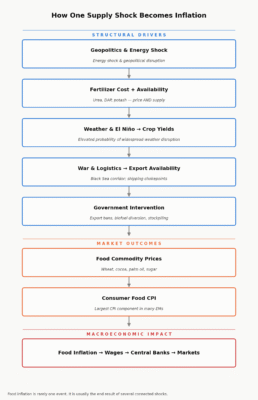
The important point is not that food prices are rising. It is that almost every stage of producing and delivering food — inputs, weather, logistics, and policy — is becoming more vulnerable at the same time. Fertilizer supply is disrupted. A historically strong El Niño is building. A major grain corridor is under sustained attack. Shipping and insurance costs are rising alongside these disruptions. None of these alone would justify calling 2027 a food inflation cycle. Together, they describe one.
This note treats food inflation as a systems problem, tracing the shock through five layers of the value chain — Inputs, Production, Logistics, Policy, and Markets — to show how stress in each layer reinforces the others. It is analysis of public data and forecasts, not investment advice.
Why Food Inflation Deserves Institutional Attention
Food represents 30–50% of household consumption in emerging and frontier markets, versus roughly 13% in the US — so it transmits into headline inflation, wages, and political stability fastest in the markets many institutional allocators are most exposed to: India, Indonesia, the Gulf, Sub-Saharan Africa, Latin America. FAO index spikes in 2008 and 2010–11 are widely cited as contributing pressure behind unrest and, in 2011, the Arab Spring; in 2022, Russia’s invasion of Ukraine pushed the index to an all-time high. In each case, the effect did not stay contained to grocery bills — it moved through wages, subsidy budgets, political risk premia, and eventually central bank reaction functions.
Layer 1 — Inputs: Fertilizer Is the First Domino, and Price Is Not the Whole Story
Modern crop yields are fertilizer-dependent, and production is geographically
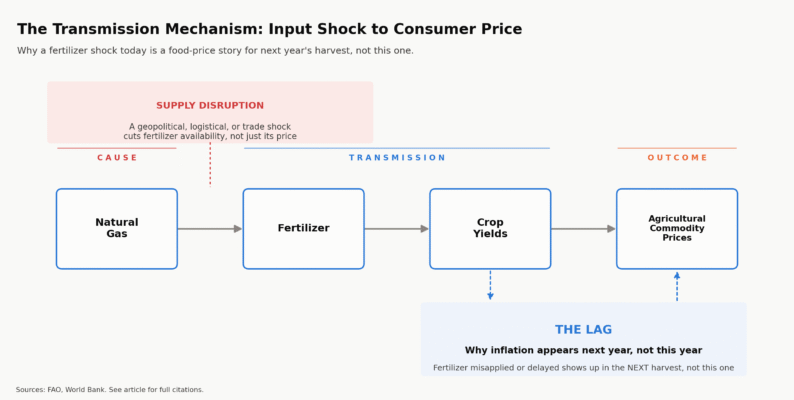
concentrated: Russia, Belarus, Qatar, Saudi Arabia, Iran, and China dominate global trade in nitrogen (urea, ammonia), phosphate (DAP), or potash. On February 28, 2026, US and Israeli strikes on Iran triggered the closure of the Strait of Hormuz; shipping traffic through it collapsed roughly 95%.4 Because the Persian Gulf accounts for an estimated 30–35% of global urea exports and 20–30% of ammonia exports, the same closure that sent Brent crude to $126/barrel hit fertilizer just as hard: the World Bank’s fertilizer price index surged to a post-2022 high in March 2026 — its second-largest monthly jump in a decade, driven by a more than 50% month-on-month spike in urea —and is now projected to rise 31% for the full year, with urea specifically forecast up 60%.
It is worth separating two distinct effects that get conflated. Higher fertilizer prices squeeze farmer margins and raise production costs — a cost problem, absorbed (imperfectly) through the season. Lower or delayed fertilizer availability is a different and more serious problem: agriculture cannot postpone application to wait for prices to fall, because fertilizer must be applied within a fixed window in the crop cycle. If urea fails to reach India, Brazil, or Southeast Asia during that window, the result months later is not a cost line item — it is a physical yield loss. FAO’s Director-General has made this explicit: “Agriculture operates within a crop calendar that cannot be postponed… if [fertilizers] do not arrive on time, yields are reduced.”³ That is why a fertilizer shock in H1 2026 is a food-inflation story for 2027, not 2026.
Layer 2 — Production: A Historic El Niño Meets an Already-Damaged Black Sea
NOAA’s Climate Prediction Center sees a greater than 90% probability of a “very strong” El Niño through fall/winter 2026–27, and a 69% probability that the October–December event reaches a magnitude that would exceed previous El Niño events dating back to 1950.6 NOAA itself is careful to qualify this: “with an event of this magnitude, the chances of experiencing impacts consistent with El Niño are larger, but they are not guaranteed.” The more defensible claim is not that drought is certain in any one region, but that a historic-strength event materially raises the probability that several vulnerable growing regions — India, Southeast Asia, West Africa, parts of South America — face adverse weather simultaneously. India has already recorded its warmest August since 1901, with
the June–August monsoon 13.8% below normal and roughly half the country registering deficient rainfall; the IMD has linked this directly to “strong El Niño conditions.”7 In West Africa, Ghana’s 2026/27 cocoa harvest is forecast down 13% on El Niño and disease pressure, per Bloomberg, with Ivory Coast’s main crop tracking a similar decline — the two countries supply more than half the world’s cocoa.8
Separately, the Black Sea corridor remains an active war zone, not a settled 2022 story. An August 12 strike on Novorossiysk knocked out terminals handling a large share of Russia’s wheat export throughput, prompting warnings from Ukraine about global food markets.9 Russia normally ships about 46.3 million tonnes a year — roughly 90% of its seaborne grain exports — through Azov and Black Sea ports; with that route disrupted, exporters are shifting toward the Baltic, where total capacity tops out near 7 million tonnes a year, and Russia’s own grain industry body estimates that all alternative routes combined can realistically replace only about half of normal Black Sea volume.¹0 Ukraine faces the mirror problem: with the Black Sea ports that once handled 90% of its exports effectively blocked, roughly 80 vessels were queued off the Danube’s Sulina Canal in late August, waiting on a route that clears only a fraction of normal daily throughput.¹0 Two independent supply shocks — one climatic, one geopolitical — are now running concurrently rather than in sequence.
Layer 3 — Logistics: Chokepoints, and How Dynamic They’ve Become
Layer 4 — Policy: When Domestic Priorities Remove Supply From Global Markets
moving strategic commodity exports, including palm oil, under a new state entity from January 2027).¹² These are not identical policies, but they share a mechanism: each converts supply that would otherwise reach global markets into supply reserved for domestic use, and in 2008, 2011, and 2022, restrictions of this kind reliably amplified — though did not originate — the underlying price shock.
downward revisions to 2026 production, now forecast near 2,982 million tonnes — down 2% from 2025’s record.¹³ That is precisely why the world has not yet seen another 2022-style food- price spike: inventories have so far absorbed the shocks already in progress. By FAO’s own latest figures, world cereal stocks are on track for roughly 947 million tonnes at the close of 2026/27 — about 0.2% above opening levels — with the global stocks-to-use ratio at 31.6%, down only
slightly from 31.9%. Underneath that headline, coarse grains (maize, barley) are being revised down 3.4%, wheat stocks are expected to rise on higher opening levels in Russia and Ukraine, and rice stocks are down about 2.7% from their record. FAO's own chief economist frames the tension well: "Agrifood systems appear robust at a production level, but risks are growing and
many of them have the potential to have rapid and adverse effects."¹³ The 2027 thesis therefore does not begin from a global grain shortage. It begins from the possibility that today’s inventory buffer proves less resilient than markets currently assume if fertilizer availability, weather, logistics, and trade disruptions continue to reinforce one another.
Layer 5 — Markets: Stress Is Broadening
Pulling the layers together, stress across the complex is becoming increasingly broad-based, even where not every commodity has moved by the same magnitude: wheat futures up roughly 43% year-on-year against a 22% year-on-year decline in US ending stocks;¹⁴ the FAO index at its highest since late 2022, with sugar up 11.9% in a single month on lower European and Asian output; West African cocoa production tracking down double digits; palm oil forecast toward $1,500/tonne as Indonesian policy and El Niño reinforce each other; and fertilizer input costs up 30–60% depending on the product.¹⁵ Second-round effects are less discussed but matter: higher corn and soybean-meal costs feed into livestock and dairy production costs, and US industry outlooks already point to rising beef, poultry, and egg prices independent of this thesis — livestock inflation typically lags a grain shock rather than leading it, which means current food CPI prints may understate where this cycle is heading.¹⁶
The 2027 Case, Stated Plainly
No single layer justifies a “broad-based cycle”; call alone, and — as Layer 4 shows — this is not a story of imminent global shortage. What has changed is that fertilizer input costs, a historically strong El Niño, an escalating Black Sea conflict, rising logistics costs, and early-stage food nationalism are live simultaneously, at a moment when the buffer in specific commodities (corn,
barley, rice) is thinner than the comfortable headline number suggests. This is not one house view. The ECB's own June 2026 Eurosystem staff projections show euro-area food inflation peaking at 3.7% in Q2 2027, explicitly citing higher international food and energy commodity prices and the gradual pass-through of the energy shock into non-energy costs — even as the
ECB expects headline inflation to ease as the direct energy effects fade.¹⁷ JPMorgan separately forecasts global food inflation roughly doubling, from 2.8% to 5%, over the same window, citing fertilizer, El Niño, and stockpiling behavior as its named drivers.³ Different institutions are therefore identifying the same transmission window, even if they differ on the scale and geographic consequences of the shock.
Market Implications — A Directional Framework, Not a Recommendation
Plausible tailwinds: fertilizer and agricultural input producers, farmland, commodity trading houses, water/irrigation infrastructure, cold-chain logistics, dry bulk shipping. Plausible headwinds: consumer staples with limited pricing power, food service, low-margin grocery retail, and food-import-dependent emerging markets. This is a framework for diligence, not a set of positions — company-specific pricing power, hedging, and geography will decide actual
outcomes.
Risks to the Thesis
The case weakens if: El Niño underperforms its probability-weighted forecast (NOAA's own caveat above); a Russia-Ukraine peace process holds and restores Black Sea throughput; Hormuz de-escalates durably; non-Gulf fertilizer producers ramp up faster than expected; governments subsidize rather than restrict; a growth slowdown compresses demand faster than supply tightens; or the comfortable aggregate stocks-to-use picture extends to the specific commodities under strain. Several of these are already partially underway — prior Hormuz and Black Sea de-escalation attempts have each failed and reversed, which cuts both ways. Commodity prices and production forecasts here are as of early September 2026 and remain subject to revision.
What to Watch
FAO Food Price Index; NOAA ENSO updates through October–December; urea and DAP spot prices; the Indian monsoon; Black Sea throughput and Danube queue lengths; Panama Canal draft decisions; global wheat and rice stocks-to-use; and futures curves for wheat, sugar, and palm oil. A move in any one is noise. Simultaneous deterioration across several is the signal.
The Point Worth Remembering
The 2027 food inflation thesis does not require every risk above to materialize — that may be the most important sentence in this note. Fertilizer is already more expensive and, in places, harder to get. El Niño is already strengthening. Black Sea grain logistics are already impaired. Shipping constraints are already appearing. Governments are already prioritizing domestic security over
frictionless trade. Some of these pressures will reverse; some crops will surprise positively; some prices will fall.
But several of the global food system's shock absorbers — fertilizer availability, reliable trade corridors, predictable weather, and cheap logistics — are weaker than they were a year ago, even as aggregate grain inventories remain adequate for now. The better question for investors is not whether any single event is large enough to cause another food price shock. It is what happens when several modest shocks arrive together — before inventories, supply chains, and policymakers have had time to absorb the first one.
This is a research-style thought piece based on publicly available data as of early September 2026. It is not investment advice; figures should be independently verified before use in any investment decision.
Sources: